Starting the 8th day of Chanukah 5781, you will receive a daily few minute WhatsApp voice note based on teachings from the Piaseczna Rebbi’s groundbreaking work Chovat HaTalmidim. We will begin with his introduction addressed to parents and educators and hope to complete it in time for Pesach 5781.
I look forward to beginning this conversation together with you, adapting these timeless chassidic teachings to our generation’s parenting and educational realities.
This past month our Elementary School embarked on the “Be a Mensch” Project which aimed at recognizing carefully selected Middot Tovot (good character traits) in others. What a wonderful sight it was to see students, faculty and staff literally wearing their good behaviour as badges of honour. In Hebrew the word for clothing, madim, and for character traits, middot, are etymologically related. The message: we wear our actions, good or bad, on our sleeves.
This week’s parsha is devoted almost exclusively to the bigdei kehunah (priestly garments) of the regular kohanim, who wore four garments and the Kohen Gadol, who wore eight. Many commentators offer significant messages that are conveyed by the structure and form of the various items of clothing. The ultimate purpose of these beautiful uniforms was “l’kavod u’l’tiferet” – for the honour and glory of the Ribbono Shel Olam (Shemot 28:2).
Among the special garments described in our parasha that were worn by the Kohen Gadol is the Me’il, the Robe – (Shemot 28:31-35). The Me’il was long enough to come down to the feet of the Kohen Gadol and along the bottom hem, it was decorated with a series of 72 pomegranates made of blue, purple and scarlet wool, and golden bells each with a ringer. According to Rashi, the pomegranates and golden bells alternated all around the bottom of the Me’il. These pomegranates and bells were both decorative and functional:
“It must be on Aaron in order to minister, its sound shall be heard when he enters the Sanctuary before Hashem, and when he leaves, so that he not die.” (Shemot 28:35)
There are a many interpretations on the significance and purpose of the bells, as well as many lessons to be learned. Some suggest their sounding being intended for the people’s ears (Rashbam, Chizkuni), some suggest they were intended for Hashem Himself and/or the angels (Ramban) and others describe the bells along with all the priestly vestments as serving as a Kapara (atonement) for different sins of the Jewish people including unintentional murderers (Yerushalmi), or for lashon hara (Kli Yakar).
But, what if the bells’ message was also intended for the Kohen Gadol himself? What was the lesson learned for the spiritual leader of the Jewish people as he heard the sounding of the bells while entering and exiting the Sanctuary?
Perhaps a message was that in order to successfully lead, to be heard and to be followed, he had to understand that his role was to be servant first. Only when he would act in the best interest of his people – “l’sharet” – then they would follow him – “V’nishma Kolo”.
In an essay called The Servant as Leader, first published in 1970, Robert K. Greenleaf coined the phrase “servant leadership”, which elaborates on this idea. He writes:
“The servant-leader is servant first… It begins with the natural feeling that one wants to serve, to serve first. Then conscious choice brings one to aspire to lead. That person is sharply different from one who is leader first, perhaps because of the need to assuage an unusual power drive or to acquire material possessions.”
Greenleaf continues: “The difference manifests itself in the care taken by the servant-first to make sure that other people’s highest priority needs are being served. The best test, and difficult to administer, is: Do those served grow as persons? Do they, while being served, become healthier, wiser, freer, more autonomous, more likely themselves to become servants? And, what is the effect on the least privileged in society? Will they benefit or at least not be further deprived?”
According to Greenleaf, a servant-leader focuses primarily on the growth and well-being of people and the communities to which they belong. While traditional leadership generally involves the accumulation and exercise of power by one at the “top of the pyramid,” servant leadership is different. The servant-leader shares power, puts the needs of others first and helps people develop and perform as highly as possible.
Perhaps we can say that Moshe Rabbeinu models servant-leadership for his brother Aaron and all future leaders, by “recusing” himself from this week’s parasha altogether, which proves to be the only parasha since his birth that his name is not mentioned. He steps aside temporarily into anonymity to bring out the autonomy and full service of Aaron.
The Me’il was an important reminder for the spiritual leader of the budding Jewish civilization in the desert, and an important lesson for community leaders, school leaders, classroom leaders, and parent leaders everywhere that tolead is to recognize the best in others and cultivating their talents first. Then, they will follow.
In tribute to Eddie Schachter, z”l, and shul Candy Men everywhere.
Every synagogue includes a supporting cast of unofficial, self-appointed characters that make shul a more colourful experience. They include, among others: “the knocker” who carefully reminds us of special prayers to insert on special days, the “shusher” (self-explanatory), the late morning nap taker who keeps the Rabbi’s ego in check, the Kiddush club enabler who clears the room during Haftorah, and the Hatzolah guy whose radio is just loud enough for everyone to hear.
But of all of them, the most beloved and arguably the most impactful person is the Candy Man. He is the man in Shul who brings a smile to countless children’s faces with a simple piece of candy (or three) on Shabbat, and has them coming back week after week. For a kid in synagogue, he is the only person that matters.
The Candy Man is not elected, he is not represented on the institution’s letterhead. He is often scorned by parents for the sugar high they will have to deal with, and conspiracy theorists have accused him of colluding with local dentists (never proven!). But, if the survival of Judaism is dependent on the next generation, there is no doubt that he could be the most important person in the synagogue.
Many have tried and failed at the position perhaps due to poor merchandise choice or distribution policies that are too strict. What many don’t understand is that being the Candy Man is about more than the candy. It’s about ensuring that the next generation of Jews have a positive association with synagogue.
It takes special skill, sensitivity and patience to be the shul Candy Man, as the clientele is diverse, complex and sometimes tricky.
There is the tentative customer who approaches eyes shyly to the ground and then dashes instantly once the candy hits the palm of his hand. There is the kind and gracious child who smiles and says: “thank you”, melting the Candy Man’s heart. There is the child who is accompanied, almost forcefully, by his father who won’t let him leave until she says: “thank you”. And there is the child who comes back moments later with a request for another candy for “his little sister”.
Each Candy Man has a style of his own. Some give lollipops, others an assortment of packaged delights. Some give hard candies, others chewy or jellied ones. Some offer choice and others don’t. Some give only one per Shabbat, some handfuls and others encourage coming back for more. Some may require a “thank you”, or “Good Shabbos” in return, others are satisfied with a simple smile.
My father-in-law affectionately known to two generations of kids in Toronto as “Sabba Bazooka”, has a strict one Israeli Bazooka gum and a “Good Shabbos” in return before escaping policy.
Candy Men can be very territorial. While they are not assigned a specific zone in the sanctuary to operate in, once they establish themselves, they often resent competition for customers.
At the end of the day, with nothing really expected in return, the Candy Man’s mission is that every Jewish child have the opportunity to have at least one sweet and warm moment in synagogue and hopefully have him come back for more of those moments.
Perhaps one of the earliest hints to Candy Men in Jewish life, is an interesting 12th century German custom described in Sefer Harokeah, written by R. Eleazar of Worms, of bringing a child to school for the first time on Shavuot, the day the Torah was given.
They would come wrapped in a cloak, and were put on the lap of the Rabbi who would bring a slate with written verses from the Torah and the Aleph-Beit. He taught the child the verses and the letters and the child repeated them. And then Rabbi put a little honey on the slate and the child licked the honey from the letters with his tongue.
The message was clear, namely that from an early age learning had to be enjoyable. Torah, as well as all of Jewish life, can only be transmitted effectively if it is delivered in a sweet and gentle fashion.
The “World Series” in the life of the Candy Man has always been Simchat Torah, the day on which we celebrate the completion and restarting of the Torah cycle. Showering children with sweets to no end, seeing kids dancing and singing with the Torahs, is the highlight of the year for every Candy Man as he sees his mission fulfilled to its fullest.
As we celebrate and begin the Torah anew, recommitting ourselves to its transmission to future generations, let us be reminded by the Candy Men everywhere to teach it with love, as its ways are ways of pleasantness and sweetness.
Eddie Schachter, z”l, was a Holocaust survivor and Montreal legend. Eddie’s passion was caring for children as TBDJ’s legendary “Candy Man”, supporter of Jewish education and needy families. Yehi Zichro Baruch.


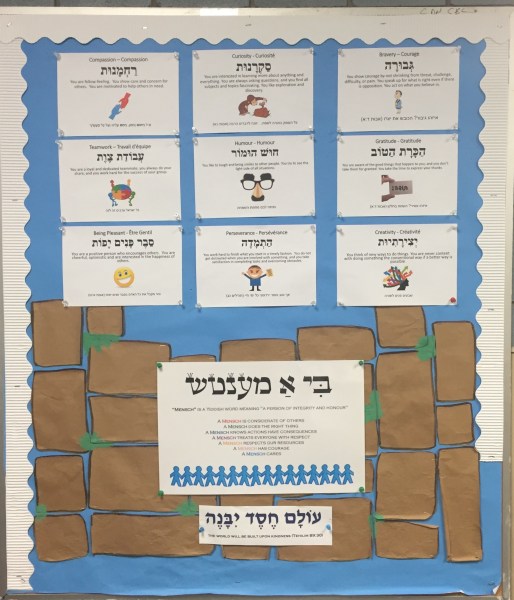 This past month our Elementary School embarked on the
  Among the special garments described in our parasha that were worn by the Kohen Gadol is the Me’il, the Robe – (Shemot 28:31-35). The Me’il was long enough to come down to the feet of the Kohen Gadol and along the bottom hem, it was decorated with a series of 72 pomegranates made of blue, purple and scarlet wool, and golden bells each with a ringer. According to Rashi, the pomegranates and golden bells alternated all around the bottom of the Me’il. These pomegranates and bells were both decorative and functional:
 rEddieTalk