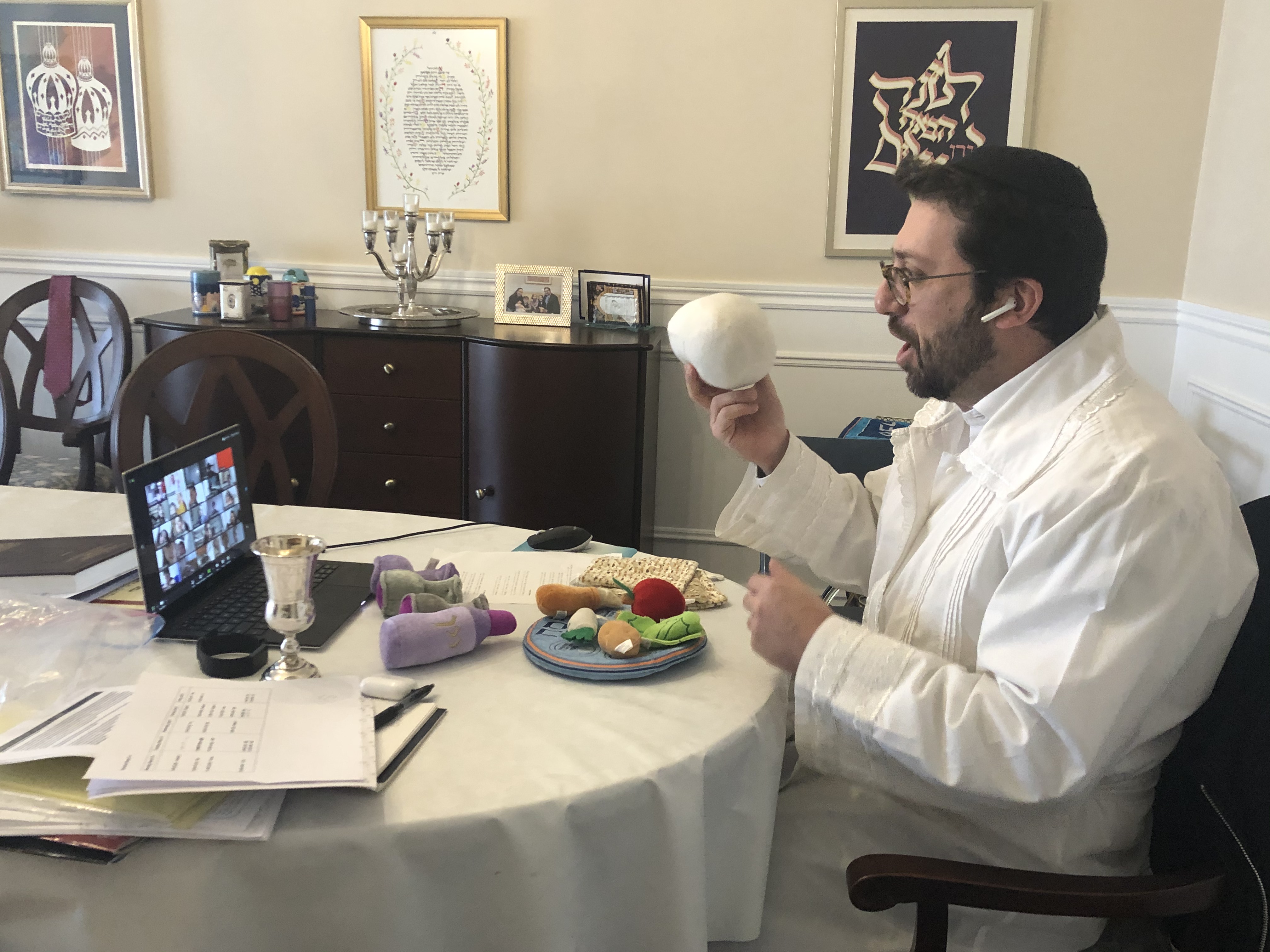
Starting the 8th day of Chanukah 5781, you will receive a daily few minute WhatsApp voice note based on teachings from the Piaseczna Rebbi’s groundbreaking work Chovat HaTalmidim. We will begin with his introduction addressed to parents and educators and hope to complete it in time for Pesach 5781.
I look forward to beginning this conversation together with you, adapting these timeless chassidic teachings to our generation’s parenting and educational realities.
Over the last 6 weeks, like most, I have felt a whirlwind of emotion – from sadness, fear and grief to empathy, joy and hope. Sometimes these feelings are felt on their own, but usually they come all intertwined. Even though this is certainly normal for these extraordinary times, it doesn’t make it any easier.
A new emotion popped up recently – a feeling of guilt. While I am certainly grateful to still have a job, unemployment has been a critical mass casualty of this crisis. I watch as friends and colleagues face the most acute challenges of the pandemic with great courage and bravery – whether medical professionals on the frontlines, clergy performing unimaginable types of funerals, community volunteers bringing people who are isolated meals, and the like. And so I ask myself, what am I doing professionally? How am I contributing?
Are you, my colleagues, and I, sitting in the comfort of our homes, essentially asking young people to get off the couch and their screens, only to tell them to sit back on the couch and get on a screen? Are we a digital babysitting service for the young and a fancy means of keeping teens out of trouble? Are we “virtually” teaching or are we “actually” teaching?
But of course, while there is value and some truth to those aspects of our work, keeping the young busy so that the acute essential services can run smoother, we are doing and accomplishing much more than that. And I hope we are learning that ours are also essential services, albeit in a different way.
I worry deeply about the impact this crisis will have on our students, now and in the long term, on so many levels – spiritual, emotional, psychological, physical. My hope, of course, is that they, and we, all emerge healthy and safe, AND one foot taller – ever changed for the good.
I recently had a breakthrough discussion with our high school Seniors. Since the beginning we knew they would be the most intensely affected group from our student body. While they may sometimes mask and try to numb their distress, as they watch all of their most anticipated senior year events cancelled one by one, their heartbreak is there nonetheless.
We discussed the difference between maasim(deeds) and middot (character), in the context of study of Pirkei Avot (Ethics of the Fathers) – essentially the central Jewish character guide book. We spoke about the distinction between BEING Jewish and DOING Jewish.
While deeds and character may be interdependent, they are often mistakenly interchanged. For example, a person can perform a kind act (deed), but that doesn’t necessarily mean his kindness is refined (character). Similarly, a person can perform an unjust act (deed), but her sense of justice (character) can be quite upright. Who we are is not always analogous to what we do.
Together we re-discovered who the Seniors ARE. As painful as it is to have had senior trips cancelled, special events moved online, and other experiences remaining in limbo, that doesn’t change who they are. They are High School Seniors. That can only be refined, or, God forbid, can degenerate. What the Class of 2020 events and rituals look like may be influenced by COVID-19, but who they look like when they emerge as High School Graduates is up to them.
I believe this lesson is applicable to all aspects of our identity – whether as individuals, as a people, as parents, as children, as spouses, as professionals. It is especially important now.
Yes, our classrooms have moved to uncharted platforms, our textbooks are nowhere to be found. Our shared experiences have become almost unrecognizable: We have no Batei Midrash, no resource rooms, no libraries, no gymnasiums, no yards. We have been banished from our staff rooms, our offices and our common spaces. Our student-teacher interactions don’t look the same and clarity of what is to come seems ever elusive. Yet, we remain educators and it is very much in our hands to make our “virtual” schools very real.
We are still educators. That can only be refined, or, God forbid, can degenerate. What our teaching looks like may be influenced by COVID-19, but who we look like as educators when we emerge and when we return to our beloved schools is up to us.
In short, thank you for being you.
Thank you for your courage to show up and be part of society’s essential services, shepherding a generation of young people through these challenging times with professionalism and creativity, with care and compassion, with empathy and patience, so that they can emerge one foot taller from this extraordinary experience.
Thank you for being educators.
B’vracha (with blessing) ve’ahava (and love),
Eddie Shostak.
After returning this week from accompanying a group of our senior class to Washington, D.C., the political nexus of the United States, I remain in awe of DC as an educator’s playground. Within the vast National Mall one can weave in and out of educationally rich museums, historic monuments, moving memorials, and breathtaking sights. My most favorite places, especially as an educator, for many reasons has always been the Lincoln Memorial.
Built in honour of the 16th President of the United States of America, Abraham Lincoln, the mammoth Greek temple style building houses a giant sculpture of a calm, kind and compassionate looking seated President. Lincoln is flanked by inscriptions of his well-known “Gettysburg Address” and his second Inaugural Address on the inner facades.
The steps of the memorial has been the site of many famous speeches, including probably the most recognized “I Have a Dream” speech, delivered by Martin Luther King Jr., a defining moment of the civil rights movement in America. The gathering on August 28, 1963 drew an estimated 250,000 people in front of the iconic steps of the Lincoln Memorial and flanking the majestic Reflecting Pool.
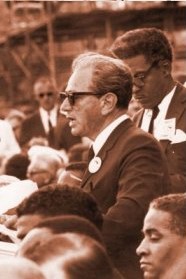
What is less known is that moments before MLK delivered his historic speech, it was an american Rabbi —Rabbi Joachim Prinz who addressed the multitudes gathered. In his stirring speech, he said:
“…it is not merely sympathy and compassion for the black people of America that motivates us. It is above all and beyond all such sympathies and emotions a sense of complete identification and solidarity born of our own painful historic experience.
When I was the rabbi of the Jewish community in Berlin under the Hitler regime, I learned many things. The most important thing that I learned under those tragic circumstances was that bigotry and hatred are not the most urgent problem. The most urgent, the most disgraceful, the most shameful and the most tragic problem is silence.”
In one of her exceptionally brilliant discourses, Biblical scholar Nechama Leibowitz, offers a compelling analysis of the role that exile plays in the history of the Jewish people.
Professor Leibowitz refers to a number of Midrashim that regard the sufferings and the exiles of the Jewish people, not as punishment, but as a source of inspiration, one that serves a critical educational purpose.
Citing a host of pesukim (ex. Shemot 22:20 which declares that one must not wrong a stranger or oppress him), she attributes the reason for our many directives towards highly moral behavior to the fact that Jews must always remember that they were once strangers and slaves in the land of Egypt. All are lessons that the Jewish people were supposed to learn from their own bitter experiences in Egypt.
In these weeks as we engage ourselves in the national introspective days of Yom HaShoah and Yom HaZikaron and national celebratory days of Yom Ha’Atzmaut and Yom Yerushalayim, may we be inspired to look inwards towards our national historic experiences AND act outwards with kindness and compassion towards a more moral and ethical society – לתקן עולם במלכות ש-די – towards a moral and ethical society in God’s Kingdom.
This past summer, my family and I were Shabbat guests at Camp Moshava Ennismore. Just as the stars were coming out, we marched down to the synagogue, escorting out the Shabbat Queen together with the chanichim (campers) and tzevet (staff). All of a sudden, my soon-to-be six-year old son turned to me and uttered in the sweetest and most innocent of ways: “Abba, I wish it was Shabbos every day.”
With those unforgettable words ringing in my ears, I was left wondering, what is the essence of camp and how can we bring a little of that magic back to the city?
I grew up in camp. From city and sports day programs to 11 years as a sleepaway camper and staff member, camp offered the fondest of memories, experiences that helped shape my identity, and relationships that went deeper and beyond that “bridge to summer.” Back home, my friends and I obsessively reminisced about the previous summer during the first five months of the school year, and we devoted the next five months to enthusiastic anticipation of the next summer. Camp was exciting; camp was magical. In tribute to the iconic film Field of Dreams, in camp one can picture asking: “Is this Heaven?” “No, it’s [insert random country town here].”
After conducting hundreds of interviews of campers and former campers, psychologist Dr. Michael Thompson concludes in his book Homesick and Happy: How Time Away from Parents Can Help a Child Grow that “many young people do not really know how strong they are, how competent they are or even who they are until they get away from their parents and test themselves in a new and challenging environment.” Thompson writes that many children told him the best thing about camp was, “I can really be myself here.”
As a city educator, I have often felt envious of camp educators. It’s not enough for me that our students look forward and backward to that special camp feeling. I want them to have that feeling now and in the summer.
Summer camps are incubators for Jewish life. No matter what the activity, from baseball and boating to crafts and campfires, camp is a 24/7 immersion in Jewishness. This is the great limitation of city life. With all the distractions and pressures, how can we compete?
So, I set out to speak to the director of that same camp where I spent Shabbat, to see what we could learn from her and import into our school life. To my amazement, as I opened the conversation, she, who had been joining our high school minyan for several weeks reciting kaddish for her late father, commented that she was impressed with the decorum, rhythm, and engagement of our middle and high school students during tefillah, while at the same time she observed similar challenges in instilling inspiration during tefillah at camp. She was interested in putting our minds together on the issue of improving tefillah and perhaps other areas.
I was shocked. I was primed to import some of that camp magic into the city. Meanwhile, she wanted the same in the other direction. This was the first step toward partnership and mutual learning.
And why not? Why should I be shocked? We’ve worked hard to build strong tefillahhabits, moving toward more creative, educationally sound approaches for girls in an Orthodox setting. We are working toward more innovative, 21st century Judaic classrooms. We are helping to develop a growth mindset in our teachers, staff, and students. We work toward good habits of order, decorum, and limits. Why shouldn’t camp benefit from these things? Why shouldn’t we develop a common language?
We need to build educational bridges from camp to the city and from the city to camp and to create seamless transitions from one to the other, with each maintaining its uniqueness.
Bridge Building
Over the last few years we have seen examples of summer camp successfully invading the city. Examples such as Moshava Ba’ir Toronto and Camp Ilan (Montreal) bring into the city a taste of the summer camp atmosphere and are educationally aligned as well. My children attended both camps this summer, and it was amazing to see them sharing in the joy of unique camp cheers and dances with their cousins who attended Camp Moshava Ennismore. Our synagogue has taken this one step further by creating Camp Ilan @ TBDJ, where there is an overlap of counselors and youth leaders, as well as educational programming.
More “invasion” is needed. Schools, shuls, and community organizations could partner with camps to staff school Shabbatonim, programming, and trips with camp-trained and -branded educators. This bridge would contribute to activating a fluid expansion of camp energy and spirit into the city.
And it goes the other way as well. The best and most current educational practices can be transposed to camp. Setting clear learning goals, creatively assessing their effectiveness, and addressing differentiated learning methodologies could have tremendous benefit to camps. Inviting city educators more often to contribute to the camp in different ways would go a long way toward building that bridge.
Aligning Goals
Ultimately, the key to building that bridge is to ensure that our goals are aligned. Are we creating institutions where our students can fully be themselves? Are we creating supportive environments and opportunities where our students can discover who they are, Jewishly? Are we allowing them to explore their interests, to experience Jewish life, placing less emphasis on skills and more on kavanah?
Our schools could pay closer attention to the core strengths of camp, including, according to Dr. Thompson, the cultivation of imagination and creativity, elimination of judgment and unnecessary pressure, intentional character development, meaningful daily rituals, fostering of independence, self-esteem, and identity, building a social community, connecting with nature, mentoring, and leadership training.
And our camps can pay closer attention to the core strengths of our schools, including empowering the campers to develop their learning experience, building a social learning community that is committed to the betterment of the wider society, and participating in Jewish learning that is engaging and relevant – not only tomorrow but today.
We can certainly take these core focuses and intentionally transplant them from one to the other.
Good camps and good schools are authentic, spirited, meaningful, and fun. They are orderly, educationally innovative, and socially and emotionally supportive. Creating strong educational partnerships can allow each to be stronger.
As that Shabbat in camp ended, my son told me he didn’t want to ever leave. I so wanted to grant him his wish of Shabbos every day. I look forward to fruitful conversations with our camp director, and I believe together we can work toward making that happen.
A primary role of the Jewish educator is to help his/her students to come home. Through engaging Jewish learning and meaningful Jewish experiences, students should be inspired to come home to who they are, connected to their past while looking forward to their future. Each one discovering their uniqueness and how their will uniquely contribute to bettering this world.
One of the most fulfilling roles in my work as a Jewish educator is serving as the Israel Program Advisor at our school. Part of my responsibilities is to open and guide the conversation with our seniors concerning spending their post-high school year studying in Israel. Together we discuss their hopes and their fears, their goals and their anxieties. We discuss what a year in Israel could look like, what obstacles they would need to overcome, and what type of preparation they would need in order to succeed.
Their decision, made together with their family, is never an easy one. There are a number of important considerations including: academic, emotional, financial, cultural, and more. For those who choose to go, their experience learning Torah in Eretz Yisrael, exploring the land, and interacting with its people proves to be a critical component to their day school education by solidifying, contexulalizing and completing it.
Every year I travel to visit with the students on their “turf” in their yeshiva, seminary or program. There we discuss how they are doing, whether they were adequately prepared, whether they are overcoming their anticipated obstacles, and whether they are on route to achieving their goals. We talk about their future plans and how they will reintegrate back in their home communities whether short term or long term.
I just came back from this year’s visit. It was incredible to see the students flourishing each in their own way – learning, experiencing and bringing out the best in themselves.
In addition, it is no secret that this year’s security situation has brought a new dimension to their experience. I witnessed firsthand, an inspiring and professional group of program Rabbis, educators and staff. Together with their students they have shown tremendous resilience and even more determination to make the most of their time in Israel, whether inside or outside the Beit Midrash.
I had the opportunity to visit Yeshivat Ashreinu, a wonderful and unique program, which sadly became more famous after the tragic murder of Ezra Schwartz, HY’D, earlier this year. The Rosh Yeshiva, Rabbi Gotch Yudin, is a model of principled leadership emanating from true Torah values. He has been guiding his students and staff valiantly through a most difficult of times.
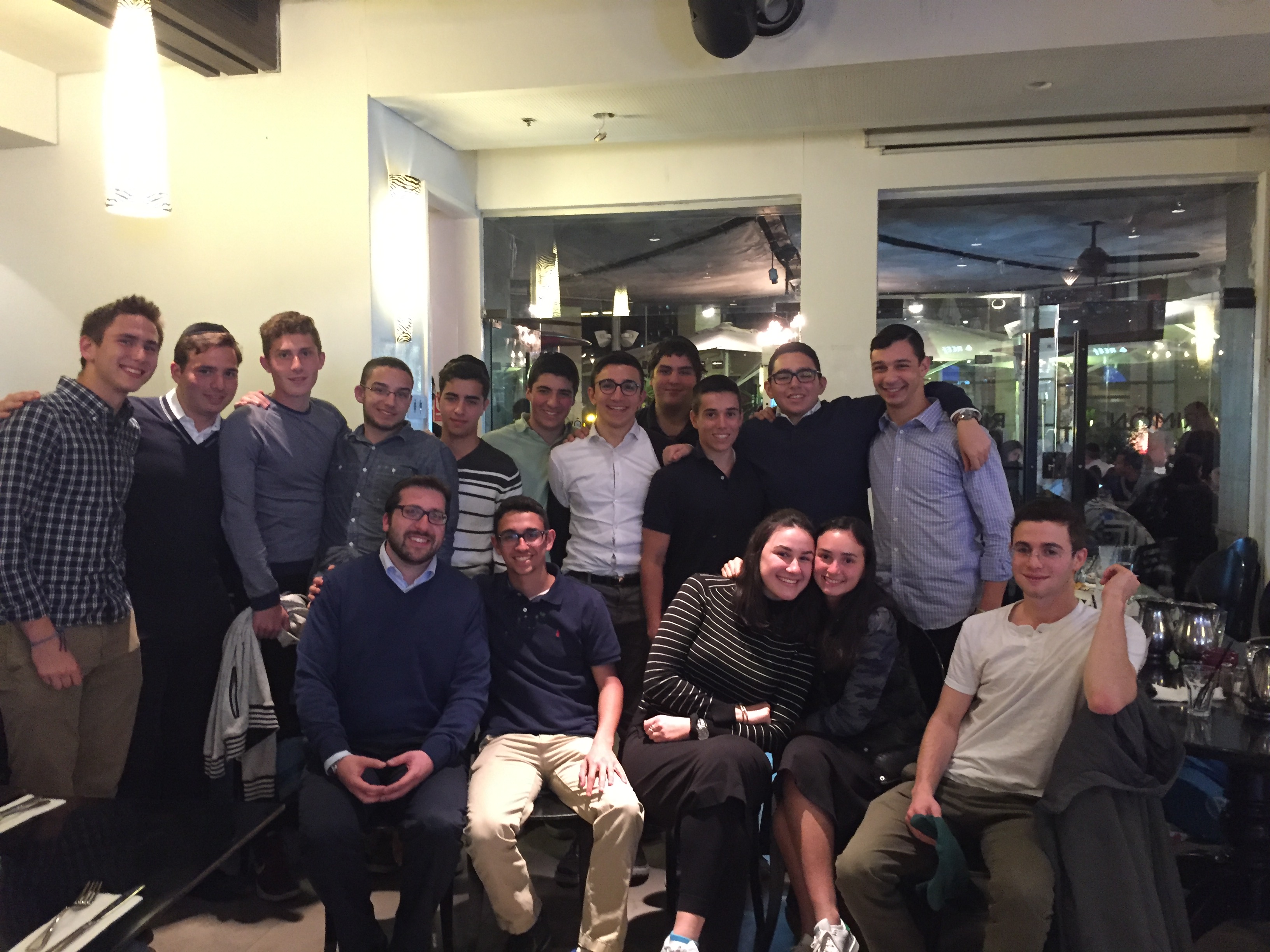
Together with all the Montreal students, we went out to dinner for a mini reunion. There, in the heart of Israel, just outside Jerusalem’s Old City gates, we ate, schmoozed, laughed and reminisced. They were curious to know how the school was doing without them and how they can help with next year’s crop coming to Israel. A few of the students shared meaningful divrei Torah and were all so grateful for this opportunity, for this gift.
Every year, my belief in the significance and importance of spending a year in Israel becomes strengthened, seeing our students at home with themselves in our nation’s home.
This past month our Elementary School embarked on the “Be a Mensch” Project which aimed at recognizing carefully selected Middot Tovot (good character traits) in others. What a wonderful sight it was to see students, faculty and staff literally wearing their good behaviour as badges of honour. In Hebrew the word for clothing, madim, and for character traits, middot, are etymologically related. The message: we wear our actions, good or bad, on our sleeves.
This week’s parsha is devoted almost exclusively to the bigdei kehunah (priestly garments) of the regular kohanim, who wore four garments and the Kohen Gadol, who wore eight. Many commentators offer significant messages that are conveyed by the structure and form of the various items of clothing. The ultimate purpose of these beautiful uniforms was “l’kavod u’l’tiferet” – for the honour and glory of the Ribbono Shel Olam (Shemot 28:2).
Among the special garments described in our parasha that were worn by the Kohen Gadol is the Me’il, the Robe – (Shemot 28:31-35). The Me’il was long enough to come down to the feet of the Kohen Gadol and along the bottom hem, it was decorated with a series of 72 pomegranates made of blue, purple and scarlet wool, and golden bells each with a ringer. According to Rashi, the pomegranates and golden bells alternated all around the bottom of the Me’il. These pomegranates and bells were both decorative and functional:
“It must be on Aaron in order to minister, its sound shall be heard when he enters the Sanctuary before Hashem, and when he leaves, so that he not die.” (Shemot 28:35)
There are a many interpretations on the significance and purpose of the bells, as well as many lessons to be learned. Some suggest their sounding being intended for the people’s ears (Rashbam, Chizkuni), some suggest they were intended for Hashem Himself and/or the angels (Ramban) and others describe the bells along with all the priestly vestments as serving as a Kapara (atonement) for different sins of the Jewish people including unintentional murderers (Yerushalmi), or for lashon hara (Kli Yakar).
But, what if the bells’ message was also intended for the Kohen Gadol himself? What was the lesson learned for the spiritual leader of the Jewish people as he heard the sounding of the bells while entering and exiting the Sanctuary?
Perhaps a message was that in order to successfully lead, to be heard and to be followed, he had to understand that his role was to be servant first. Only when he would act in the best interest of his people – “l’sharet” – then they would follow him – “V’nishma Kolo”.
In an essay called The Servant as Leader, first published in 1970, Robert K. Greenleaf coined the phrase “servant leadership”, which elaborates on this idea. He writes:
“The servant-leader is servant first… It begins with the natural feeling that one wants to serve, to serve first. Then conscious choice brings one to aspire to lead. That person is sharply different from one who is leader first, perhaps because of the need to assuage an unusual power drive or to acquire material possessions.”
Greenleaf continues: “The difference manifests itself in the care taken by the servant-first to make sure that other people’s highest priority needs are being served. The best test, and difficult to administer, is: Do those served grow as persons? Do they, while being served, become healthier, wiser, freer, more autonomous, more likely themselves to become servants? And, what is the effect on the least privileged in society? Will they benefit or at least not be further deprived?”
According to Greenleaf, a servant-leader focuses primarily on the growth and well-being of people and the communities to which they belong. While traditional leadership generally involves the accumulation and exercise of power by one at the “top of the pyramid,” servant leadership is different. The servant-leader shares power, puts the needs of others first and helps people develop and perform as highly as possible.
Perhaps we can say that Moshe Rabbeinu models servant-leadership for his brother Aaron and all future leaders, by “recusing” himself from this week’s parasha altogether, which proves to be the only parasha since his birth that his name is not mentioned. He steps aside temporarily into anonymity to bring out the autonomy and full service of Aaron.
The Me’il was an important reminder for the spiritual leader of the budding Jewish civilization in the desert, and an important lesson for community leaders, school leaders, classroom leaders, and parent leaders everywhere that tolead is to recognize the best in others and cultivating their talents first. Then, they will follow.




 “…it is not merely sympathy and compassion for the black people of America that motivates us. It is above all and beyond all such sympathies and emotions a sense of complete identification and solidarity born of our own painful historic experience.


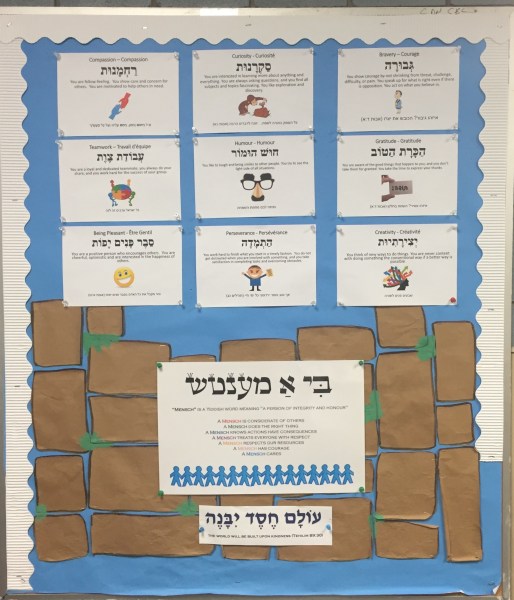 This past month our Elementary School embarked on the
  Among the special garments described in our parasha that were worn by the Kohen Gadol is the Me’il, the Robe – (Shemot 28:31-35). The Me’il was long enough to come down to the feet of the Kohen Gadol and along the bottom hem, it was decorated with a series of 72 pomegranates made of blue, purple and scarlet wool, and golden bells each with a ringer. According to Rashi, the pomegranates and golden bells alternated all around the bottom of the Me’il. These pomegranates and bells were both decorative and functional:
 rEddieTalk