Launch of New Podcast on Parenting


Starting the 8th day of Chanukah 5781, you will receive a daily few minute WhatsApp voice note based on teachings from the Piaseczna Rebbi’s groundbreaking work Chovat HaTalmidim. We will begin with his introduction addressed to parents and educators and hope to complete it in time for Pesach 5781.

I look forward to beginning this conversation together with you, adapting these timeless chassidic teachings to our generation’s parenting and educational realities.

Join me for a “Conversation in Parenting”

We Are Educators

(external link)
May 8, 2020 By eJP
IMG_2136

(Published first by ejewishphilantrhopy)

Dearest Fellow Educators,

Over the last 6 weeks, like most, I have felt a whirlwind of emotion – from sadness, fear and grief to empathy, joy and hope. Sometimes these feelings are felt on their own, but usually they come all intertwined. Even though this is certainly normal for these extraordinary times, it doesn’t make it any easier.

A new emotion popped up recently – a feeling of guilt.  While I am certainly grateful to still have a job, unemployment has been a critical mass casualty of this crisis. I watch as friends and colleagues face the most acute challenges of the pandemic with great courage and bravery – whether medical professionals on the frontlines, clergy performing unimaginable types of funerals, community volunteers bringing people who are isolated meals, and the like. And so I ask myself, what am I doing professionally? How am I contributing?

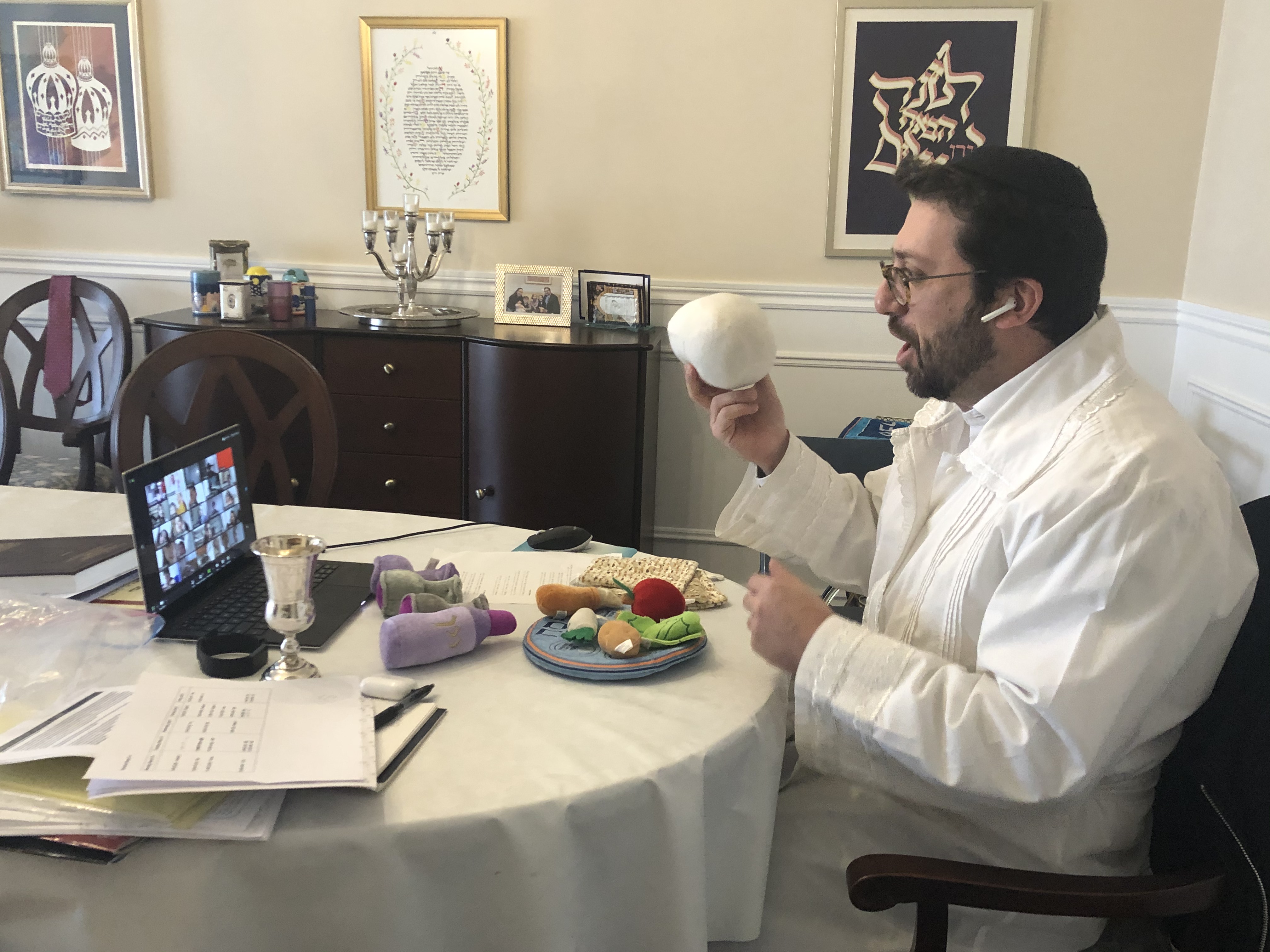
Are you, my colleagues, and I, sitting in the comfort of our homes, essentially asking young people to get off the couch and their screens, only to tell them to sit back on the couch and get on a screen? Are we a digital babysitting service for the young and a fancy means of keeping teens out of trouble? Are we “virtually teaching or are we actually teaching?

But of course, while there is value and some truth to those aspects of our work, keeping the young busy so that the acute essential services can run smoother, we are doing and accomplishing much more than that. And I hope we are learning that ours are also essential services, albeit in a different way.

I worry deeply about the impact this crisis will have on our students, now and in the long term, on so many levels – spiritual, emotional, psychological, physical. My hope, of course, is that they, and we, all emerge healthy and safe, AND one foot taller – ever changed for the good.

I recently had a breakthrough discussion with our high school Seniors.  Since the beginning we knew they would be the most intensely affected group from our student body. While they may sometimes mask and try to numb their distress, as they watch all of their most anticipated senior year events cancelled one by one, their heartbreak is there nonetheless.

We discussed the difference between maasim (deeds) and middot (character), in the context of study of Pirkei Avot (Ethics of the Fathers) – essentially the central Jewish character guide book. We spoke about the distinction between BEING Jewish and DOING Jewish.

While deeds and character may be interdependent, they are often mistakenly interchanged. For example, a person can perform a kind act (deed), but that doesn’t necessarily mean his kindness is refined (character). Similarly, a person can perform an unjust act (deed), but her sense of justice (character) can be quite upright. Who we are is not always analogous to what we do.

Together we re-discovered who the Seniors ARE. As painful as it is to have had senior trips cancelled, special events moved online, and other experiences remaining in limbo, that doesn’t change who they are. They are High School Seniors. That can only be refined, or, God forbid, can degenerate. What the Class of 2020 events and rituals look like may be influenced by COVID-19, but who they look like when they emerge as High School Graduates is up to them.

I believe this lesson is applicable to all aspects of our identity – whether as individuals, as a people, as parents, as children, as spouses, as professionals. It is especially important now.

Yes, our classrooms have moved to uncharted platforms, our textbooks are nowhere to be found. Our shared experiences have become almost unrecognizable: We have no Batei Midrash, no resource rooms, no libraries, no gymnasiums, no yards. We have been banished from our staff rooms, our offices and our common spaces. Our student-teacher interactions don’t look the same and clarity of what is to come seems ever elusive. Yet, we remain educators and it is very much in our hands to make our virtual schools very real.

We are still educators. That can only be refined, or, God forbid, can degenerate. What our teaching looks like may be influenced by COVID-19, but who we look like as educators when we emerge and when we return to our beloved schools is up to us.

In short, thank you for being you.

Thank you for your courage to show up and be part of society’s essential services, shepherding a generation of young people through these challenging times with professionalism and creativity, with care and compassion, with empathy and patience, so that they can emerge one foot taller from this extraordinary experience.

Thank you for being educators.

B’vracha (with blessing) ve’ahava (and love),
Eddie Shostak.

The Shul Candy Man

lollipops-466687_1280In tribute to Eddie Schachter, z”l, and shul Candy Men everywhere.

Every synagogue includes a supporting cast of unofficial, self-appointed characters that make shul a more colourful experience. They include, among others: “the knocker” who carefully reminds us of special prayers to insert on special days, the “shusher” (self-explanatory), the late morning nap taker who keeps the Rabbi’s ego in check, the Kiddush club enabler who clears the room during Haftorah, and the Hatzolah guy whose radio is just loud enough for everyone to hear.

But of all of them, the most beloved and arguably the most impactful person is the Candy Man.  He is the man in Shul who brings a smile to countless children’s faces with a simple piece of candy (or three) on Shabbat, and has them coming back week after week. For a kid in synagogue, he is the only person that matters.

[youtube https://www.youtube.com/watch?v=sizCBeS03YU]

The Candy Man is not elected, he is not represented on the institution’s letterhead.  He is often scorned by parents for the sugar high they will have to deal with, and conspiracy theorists have accused him of colluding with local dentists (never proven!).  But, if the survival of Judaism is dependent on the next generation, there is no doubt that he could be the most important person in the synagogue.

Many have tried and failed at the position perhaps due to poor merchandise choice or distribution policies that are too strict.  What many don’t understand is that being the Candy Man is about more than the candy.  It’s about ensuring that the next generation of Jews have a positive association with synagogue.

It takes special skill, sensitivity and patience to be the shul Candy Man, as the clientele is diverse, complex and sometimes tricky.

There is the tentative customer who approaches eyes shyly to the ground and then dashes instantly once the candy hits the palm of his hand.  There is the kind and gracious child who smiles and says: “thank you”, melting the Candy Man’s heart.  There is the child who is accompanied, almost forcefully, by his father who won’t let him leave until she says: “thank you”.  And there is the child who comes back moments later with a request for another candy for “his little sister”.

Each Candy Man has a style of his own.  Some give lollipops, others an assortment of packaged delights.  Some give hard candies, others chewy or jellied ones.  Some offer choice and others don’t.  Some give only one per Shabbat, some handfuls and others encourage coming back for more.  Some may require a “thank you”, or “Good Shabbos” in return, others are satisfied with a simple smile.

My father-in-law affectionately known to two generations of kids in Toronto as “Sabba Bazooka”, has a strict one Israeli Bazooka gum and a “Good Shabbos” in return before escaping policy.

Candy Men can be very territorial.  While they are not assigned a specific zone in the sanctuary to operate in, once they establish themselves, they often resent competition for customers.

At the end of the day, with nothing really expected in return, the Candy Man’s mission is that every Jewish child have the opportunity to have at least one sweet and warm moment in synagogue and hopefully have him come back for more of those moments.

Perhaps one of the earliest hints to Candy Men in Jewish life, is an interesting 12th century German custom described in Sefer Harokeah, written by R. Eleazar of Worms, of bringing a child to school for the first time on Shavuot, the day the Torah was given.

They would come wrapped in a cloak, and were put on the lap of the Rabbi who would bring a slate with written verses from the Torah and the Aleph-Beit.  He taught the child the verses and the letters and the child repeated them.  And then Rabbi put a little honey on the slate and the child licked the honey from the letters with his tongue.

The message was clear, namely that from an early age learning had to be enjoyable.  Torah, as well as all of Jewish life, can only be transmitted effectively if it is delivered in a sweet and gentle fashion.

The “World Series” in the life of the Candy Man has always been Simchat Torah, the day on which we celebrate the completion and restarting of the Torah cycle.  Showering children with sweets to no end, seeing kids dancing and singing with the Torahs, is the highlight of the year for every Candy Man as he sees his mission fulfilled to its fullest.

As we celebrate and begin the Torah anew, recommitting ourselves to its transmission to future generations, let us be reminded by the Candy Men everywhere to teach it with love, as its ways are ways of pleasantness and sweetness.

Eddie Schachter, z”l, was a Holocaust survivor and Montreal legend.  Eddie’s passion was caring for children as TBDJ’s legendary “Candy Man”, supporter of Jewish education and needy families.  Yehi Zichro Baruch.